


Choosing the Right Crypto Expert Witness:
Why the Category “Cryptocurrency” Is Failing Your Case
By Aviran Vargas
Director of Operations & Infrastructure, EZ Blockchain
The Category Problem
If you are an attorney searching for a crypto expert witness, every major directory will funnel you into a single classification: “Cryptocurrency.” They all do it. One category. One bucket. Every expert, from the forensic blockchain analyst to the ASIC repair technician, lumped together as though their skills are interchangeable.
They are not.
The top-level label should be Crypto, not “Cryptocurrency.” “Cryptocurrency” describes a digital asset class. It does not describe the infrastructure, the operations, the contract structures, the physical hardware, or the application protocols that make the asset possible. Using “Cryptocurrency” as the umbrella is like organizing all of medicine under a single category called “Prescriptions.” It is like filing every construction dispute under “Hammer.” It guarantees that brilliant attorneys will generalize their needs, and that generalization will cost their clients.
The Four Layers of Crypto Expertise
Crypto is not one thing. It is a stack with distinct layers, each requiring a different kind of knowledge, a different kind of witness, and a different kind of testimony. I break this stack into four layers. Know which layer your case lives on before you hire anyone.
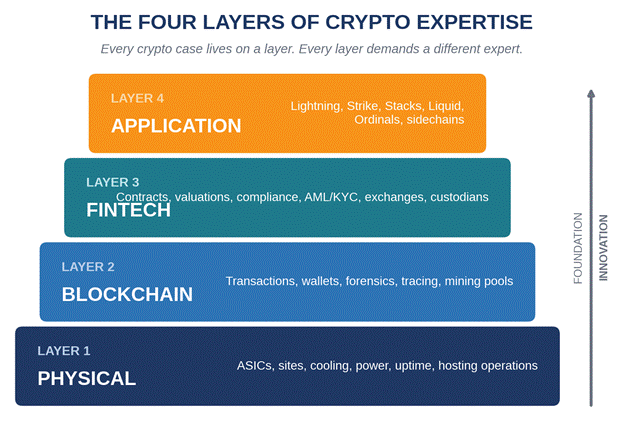
Layer 1: Physical
This is the foundation. The tangible layer. If your case involves anything you can touch, feel the heat of, or hear running at 80 decibels inside a steel container, you are at Layer 1. This layer covers:
- ASIC miners: procurement, deployment, configuration, firmware, performance tuning, and repair
- Environmental management: heating, cooling, airflow, immersion systems, humidity, and seasonal performance variation
- Site infrastructure: electrical systems, transformers, switchgear, PDUs, grounding, and arc flash safety
- Maintenance: hashboard failure rates, RMA cycles, PSU replacement, fan servicing, and component diagnostics
- Uptime and performance: pool-reported vs. nameplate hashrate, curtailment events, grid outages, and load shedding
- Decommissioning: equipment handling, logistics, and residual value
- Environmental events: floods, fires, surges, extreme weather, and their operational impact
- Hosting and service agreements: SLA terms, uptime guarantees, power pricing, penalty clauses, and performance benchmarks
- Equipment valuation: ASIC pricing, depreciation, market value vs. operational value, and residual worth
- Transaction tracing: following funds across wallets, exchanges, and mixers
- Wallet attribution: identifying ownership through clustering, exchange records, and subpoena data
- Network consensus and validation: block propagation, confirmation, and difficulty adjustments
- On-chain forensics: UTXO analysis, address reuse, heuristic linking, mempool dynamics, and fee markets
- Mining pools: pool selection, fee structures, reward distribution, and block withholding
- Hardware wallets: device security, firmware vulnerabilities, supply chain integrity. Examples: Ledger, Trezor, Coldcard
- Exchange and custodial operations: trade execution, withdrawal processing, proof of reserves, commingling, and insolvency. Examples: BitGo, Anchorage, Coinbase Custody
- Investment structures: SAFT agreements, vesting, lockup periods, and securities treatment
- Insurance and liability: business interruption coverage, equipment riders, and subrogation
- Tax and regulatory compliance: cost-basis calculation, mining income recognition, AML/KYC frameworks, FinCEN guidance, and money transmitter licensing
- Bitcoin ATMs and kiosks: operator licensing, KYC compliance, and fraud liability. Examples: Bitcoin Depot, CoinFlip, Coinhub
- Self-custody and estate matters: seed phrase compromise, SIM swap theft, succession planning, and probate involving Bitcoin
- Payment applications: off-chain and overlay payment systems for instant Bitcoin transfers. Examples: Lightning Network, Strike, Square, BTCPay Server, Zebedee
- Smart contract platforms: programmable logic anchored to Bitcoin for DeFi, lending, and decentralized applications. Examples: Stacks, Rootstock (RSK), Merlin Chain, BEVM
- Sidechains and federated systems: separate ledgers pegged to Bitcoin with their own consensus and trust models. Examples: Liquid Network, Fedimint, Cashu
- Digital artifacts and token protocols: on-chain data inscriptions and Bitcoin-native token standards. Examples: Ordinals, Inscriptions, BRC-20, Runes
- Decentralized exchanges: peer-to-peer trading platforms with no central authority. Examples: Bisq, HodlHodl, RoboSats
- Emerging protocols: next-generation systems for scalability, privacy, and programmability. Examples: Ark, RGB, Nostr, BitcoinOS
- Was the machine working at 100% of nameplate hashrate, or was it throttled, degraded, or partially offline? If so, why?
- What do the daily operational reports show? What was the hourly uptime? The 5-minute uptime granularity?
- What was the hashboard failure rate over the projection period? How many PSUs were replaced? How many fans?
- What firmware was running on the machines? Was it stock or aftermarket? Was it stable?
- What was the ambient temperature at the site? What cooling solution was deployed, and was it adequate for the load?
- Were there any grid events, curtailment orders, or voluntary load-shed periods?
- What pool was the fleet pointed at? What was the pool-reported hashrate vs. the expected hashrate?
- Was the site operating under a fixed-rate or demand-response power contract?
- What ASIC model was deployed, and does the expert’s projection account for attrition?
- What difficulty adjustments occurred during the relevant period, and how were they modeled?
- If the case involves a Layer 4 protocol, what was the channel state, bridge audit status, or peg ratio at the time of the dispute?
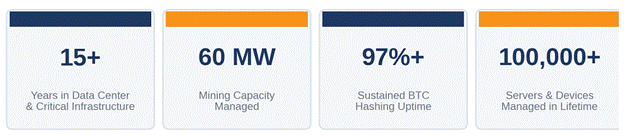
- 15+ years in data center and critical infrastructure operations
- CME Group: Tier IV data center operations, Chicago and Naperville campuses
- Comcast: National Data Center Operations, managing servers & devices
- EZ Blockchain: Directing all facility operations, infrastructure buildouts, and ASIC fleet management across multi-megawatt mining sites, managing servers & devices
- 60 MW of mining capacity managed
- 97%+ sustained BTC hashing uptime, with documented drive toward five-nines reliability
- SB3000 container deployments: personally implemented EZ Blockchain’s modular mining infrastructure
- ASIC deployment, configuration, performance analysis, and repair
- Live facility inspection and site condition assessment
- Hosting contract analysis and SLA evaluation
- Profitability modeling using real operational data
- Uptime and downtime damages calculations
- Equipment valuation, depreciation, and residual worth analysis
- Decommissioning scope, process, and cost estimation
- Rebuttal report preparation and opposing expert critique
- Layer 1 physical-layer dispute support
A blockchain analyst cannot testify credibly about any of these. Not one. These are operational facts that come from standing on a site floor, not from reading a ledger.
Layer 2: Blockchain
This is the transactional layer, and it is where most “cryptocurrency” experts concentrate. If your case is about what happened on the chain, you are here. Layer 2 covers:
A skilled blockchain forensic analyst is the right expert for this layer. They read the ledger. They follow the money. They can attribute wallets and reconstruct fund flows. But the moment they start testifying about what a miner should have done, what uptime looks like in practice, or how a curtailment event affected hashrate, they have left their area of competence and entered mine.
Layer 3: FinTech
This is the contractual and financial layer. If your case is about the business arrangements built around crypto infrastructure, you are here. Layer 3 covers:
Layer 3 cases often require a combination of financial and operational testimony. The contract says one thing. The site did another. Proving that gap requires someone who understands both the agreement and the physical reality behind it.
Layer 4: Application
This is the innovation layer. Protocols and services built on top of Bitcoin that extend its functionality and introduce their own rules. If your case involves something that rides on Bitcoin but is not Bitcoin itself, you are at Layer 4. This layer covers:
Layer 4 depends on all three layers below it. A Lightning channel dispute can trace back to a hosting contract failure that traces back to a flooded mining site. If your case crosses layers, you need one expert who understands the full stack, not four who each know one.
The Problem with Theoretical Experts
Most crypto expert witnesses working today are theoretical. They hold certifications. They have multiple degrees. They teach courses. They publish papers. They can explain how a blockchain works to a jury with polished slides and practiced delivery.
What they cannot do is tell you what actually happens in a mining facility at 2 a.m. when a transformer trips and 30 megawatts of load goes dark.
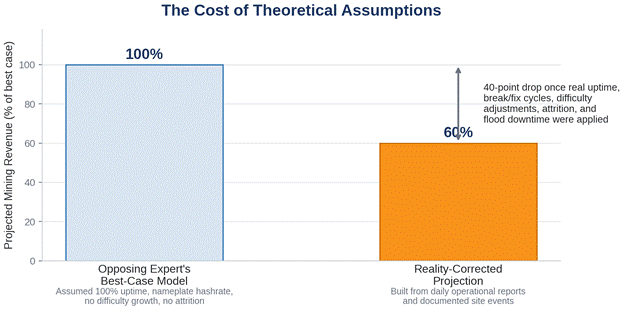
I have seen this problem firsthand. I reviewed an opposing expert witness report prepared by a highly credentialed individual with multiple advanced degrees and professional certifications. The report projected mining revenue using best-case assumptions across the board: 100% machine uptime, nameplate hashrate sustained indefinitely, no difficulty adjustments modeled over time, no equipment attrition, and stable power availability throughout the projection period.
The site in question had experienced a major flood that knocked out electrical service for several days. The expert did not know this. It was not in the report. It was not in the assumptions. It was not even acknowledged as a possibility.
Once I applied real-world corrections to his model, incorporating actual uptime data, documented break/fix cycles, difficulty adjustment impacts, equipment attrition rates, and the flood-related downtime, his projected figures fell to roughly 60% of his best-case scenario. His entire damages calculation collapsed under the weight of facts he never gathered because he had never visited a facility, let alone operated any.
Crypto mining is far more complicated than a theoretical Excel file. The spreadsheet is easy. The reality is not. And if your opposing expert has never lived that reality, a competent operator on the witness stand will expose every gap in a way the trier of fact will not forget.
Questions I Ask That Theoretical Experts Do Not
When I review a case, I start with the questions that operations professionals ask instinctively and that academics rarely think to consider:
These are not academic questions. These are operational questions. If your expert cannot answer them from experience, they are guessing. And guessing is not testimony.
What I Bring to Your Case
I am Aviran Vargas, the Director of Operations & Infrastructure at EZ Blockchain, a Chicago-based cryptocurrency hosting company that manages Bitcoin mining infrastructure across multiple U.S. facilities. I do not consult about mining. I do mining. Every day.
My operational background includes:
My expert witness capabilities include:
Case History
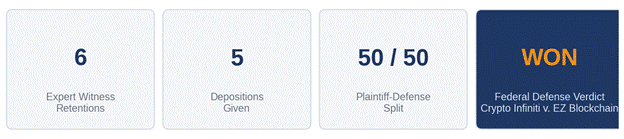
I have been retained as an expert witness six times, have given five depositions, and have worked both plaintiff and defense sides equally.
Arbitration 1: Fraud Allegations and Operational Disputes
In my first engagement, the claimant alleged fraud and substandard operations at a mining hosting facility. I was retained to assess the actual work performed at the site. I conducted a thorough site visit, inspected the infrastructure firsthand, reviewed operational records, and produced a 50-page expert report detailing the condition of the facility, the quality of work performed, and the operational data supporting or contradicting each allegation. My findings debunked the fraud claims and demonstrated that the hosting operations were conducted inconsistent with industry practice, thus proving that the plaintiff failed in their operations which led to the problems alleged.
Arbitration 2: ASIC Valuation Dispute
In the second arbitration, a central issue was the proper valuation of a specific ASIC model. The opposing expert relied on “market value” derived from secondary-market listings. I provided an operational valuation grounded in the machine’s actual revenue-generating capacity, remaining useful life, and performance characteristics. When the opposing expert submitted a rebuttal, I identified critical errors in his methodology and prepared several written rebuttals that proved highly effective. I sat in on testimony throughout the proceeding and provided daily support to the legal team. The arguments built from my operational perspective proved to be central to the outcome.
Federal Case: Crypto Infiniti v. EZ Blockchain
This federal case hinged on my testimony as an expert in Crypto Hosting Operations. The claims centered on the hosting relationship and the performance of the mining infrastructure under contract. I provided testimony grounded in day-to-day operational experience. We won the case. The court returned a defense verdict. My testimony was not theoretical. It was built on the same work I do every morning before I walk into a courtroom.
Choosing the Right Expert
When you search for a crypto expert witness, do not settle for the category “Cryptocurrency.” That category does not distinguish between someone who traces wallets and someone who manages 10,000 ASICs in a West Texas container. It does not distinguish between a professor who teaches a blockchain seminar and an operator who has diagnosed 500 hashboard failures with his own hands.
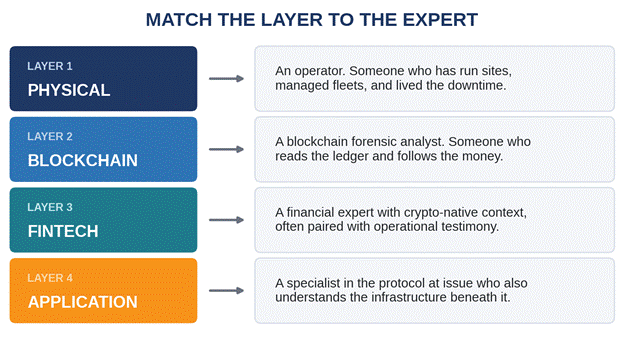
Ask which layer your case lives on. If it is Layer 1, you need an operator. If it is Layer 2, you need a blockchain forensic analyst. If it is Layer 3, you may need both, or you may need a financial expert with crypto-native context. If it is Layer 4, you need someone who understands the application protocol in question and the infrastructure it depends on. But you will not find the right person if the directory that serves you treats the entire ecosystem as one undifferentiated field.
You can find more details through BTCExpertWitness.com. I accept engagements on both plaintiff and defense sides. I respond to consultations promptly and I prepare reports that are built to survive cross-examination, because every fact in them comes from the same work I do before I sit down to write.
Aviran Vargas
Director of Operations & Infrastructure, EZ Blockchain
Crypto Hosting Expert Witness